


There are wardrobes full of clothes that still feel empty. Dozens of hangers, stacks upon stacks, and yet each morning you reach for the same three pieces. Perhaps there is already an insight in that: a wardrobe is not made by quantity — but by the connection to what you wear.
The Weight of Too Much
The average European owns between 70 and 150 pieces of clothing. Roughly 42 new items are added each year. At the same time, a garment is now worn only 7 to 10 times before being discarded — a decline of over 35 per cent in just fifteen years.
The numbers are abstract. The feeling behind them is not. The T-shirt that loses its shape after two washes. The shirt that looked promising in the shop and disappears at home. Clothes that never truly become your own.
Across the European Union, nearly 7 million tonnes of textiles are discarded each year — approximately 16 kilograms per person. Almost three quarters end up in landfill or incineration. Not because the garments were ruined. Because the relationship to them never existed.
What Remains When You Subtract
A reduced wardrobe does not begin with a list. It begins with a question: which pieces would you miss?
They are rarely the conspicuous ones. It is the T-shirt whose fabric has grown softer with the years. The shirt that suits a dinner as effortlessly as a Sunday walk. The cardigan you throw on without thinking — and that feels right every time.
The idea of a capsule wardrobe is not new, but it is often misunderstood. It is not about reducing your wardrobe to a precise number. It is about choosing each piece so that it stays. So that it is worn. So that it accompanies.
At Chirimoya, we call this for the journey — clothing made not for an occasion, but for a life. Between the clothes on your skin and the memories made while wearing them, there is a connection that only time can build.
The True Price of a T-Shirt
What a garment costs is not revealed by its price tag. It is revealed by how often it is worn.
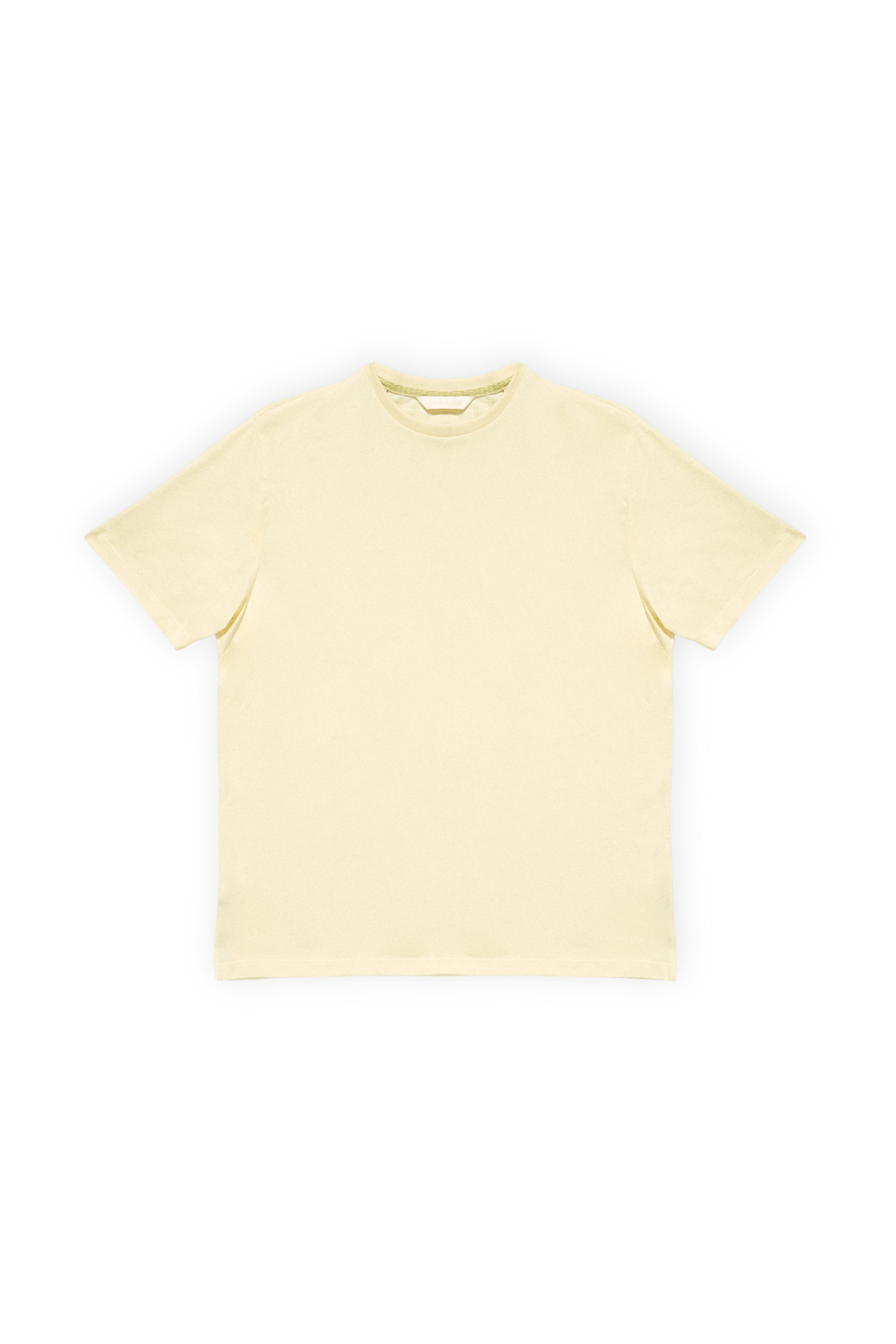
Take our Classic T-shirt in Peruvian Pima cotton. It costs €45. Worn twice a week over three years — and Pima cotton endures that effortlessly, growing more supple with every wash — that amounts to over 300 wears. Cost per wear: roughly fifteen cents.
By contrast: five T-shirts at €15 each cost €75 in total. Each lasts 7 to 10 wears before the fabric, shape, or colour fades. That is 35 to 50 wears altogether — and a cost per wear of over €1.50.
The arithmetic is simple. But it only captures half the story. What cannot be calculated: the feeling of reaching for a piece that has felt familiar from the very first touch. That need not be replaced because it does not deteriorate. That is the true value of quality — it gives you time.
Materials That Deserve Time
A reduced wardrobe only works if the few pieces within it keep their promise. The foundation is always the material.
Our Pima cotton grows in the coastal valleys of Peru, where the climate produces fibres of extraordinary length — up to 43 millimetres, silken and smooth even in their raw state. The resulting fabric does not pill, does not thin. It grows softer with every wash. It rests against the skin without clinging. It breathes.
Our Alpaca wool from the high-altitude regions of the Andes is equally remarkable. Lighter than sheep's wool, warmer than most natural fibres, and possessed of a gentleness you must feel to believe. A cardigan in baby Alpaca is not a garment for a single season. It is a companion for years.
Here, one insight suffices: when you own less, you feel more. Every fibre counts.
A Wardrobe That Breathes
Owning less does not feel like sacrifice. It feels like clarity.
You open the wardrobe and see only things you are glad to wear. No hesitation, no half-hearted compromises. A white T-shirt that fits perfectly. A Pima cotton shirt that moves from the office to dinner without missing a beat. A hoodie that is exactly right on a Saturday morning.
A reduced wardrobe is neither formula nor system. It is the result of an attitude: less, but with greater intention. Fewer decisions in the morning, more attention to what you choose. Fewer pieces forgotten at the back of a drawer — more pieces that gather stories.
There is no correct number. No minimum. No maximum. Only the question of whether every piece in your wardrobe has earned its place — not because it was expensive, but because it is worn.
The Quieter Form of Luxury
Globally, the textile industry produces over 92 million tonnes of waste each year. Less than one per cent is recycled into new clothing. Behind every number stands a garment that never had the chance to be truly worn.
In a world that produces ever more, choosing less is not deprivation. It is a decision. For quality that endures. For materials that evolve with time rather than decay. For clothing that does not replace, but accompanies.
Chirimoya is not a solution to a global problem. But every piece we create is born from the conviction that clothing can be more than a consumable. That conscious luxury need not be louder, but quieter. Not more, but enough.
Placing your faith in us is a pledge towards a more sustainable future. Each garment is designed to endure long beyond its creation, evolving with you and your style.
Frequently Asked Questions
A capsule wardrobe consists of a small number of carefully chosen pieces that combine effortlessly and transcend seasonal trends. The focus is on timeless basics crafted from quality materials — T-shirts, shirts, and knitwear — selected for their fit, feel, and ability to endure years of regular wear.
There is no fixed number. What matters is not quantity but the connection to each piece. Many proponents of a reduced wardrobe work with 25 to 40 items — versatile basics that mix easily and suit a range of occasions, from the everyday to the more considered.
Yes. The cost per wear of quality basics is significantly lower than that of mass-produced alternatives. A Pima cotton T-shirt at €45, worn regularly over three years, costs roughly 15 cents per wear — compared to over €1.50 per wear for fast-fashion garments that lose shape and softness within weeks.
Long-lasting natural fibres form the strongest foundation. Peruvian Pima cotton is prized for its exceptional softness and shape retention, while Alpaca wool from the Andes is lightweight, naturally insulating, and remarkably durable. Both fibres grow more beautiful with wear rather than declining.
Minimalism aims to own as little as possible. A capsule wardrobe places quality and intentional selection at the centre. It is not about deprivation but about curating a wardrobe in which every piece has earned its place — and is genuinely enjoyed.

Related Articles
What Makes Loungewear Ultra-Soft, and How Do You Choose the Best Quality Pieces?
Discover what truly makes loungewear ultra-soft, from fiber origin to artisan finishing, and how to judge real quality before you buy.

How Does Artisanal, Small-Batch Clothing Production Help Fight Climate Change?
How small-batch Andean craftsmanship removes carbon-heavy manufacturing from fashion and makes clothing built to last.

