Why Is Craftsmanship and Local Material Sourcing Important for Sustainable Fashion?
Why heritage craft and local materials, not waste fixes, form the true foundation of sustainable fashion. Chirimoya's Andean approach explained.

Sustainable fashion depends far more on how and where a garment is made than on recycling programs added after the fact. When a brand sources natural fibers like Pima cotton and Baby Alpaca from the regions that have cultivated them for generations, and relies on artisan hands rather than industrial shortcuts, durability and low environmental impact follow as a natural consequence. This is the foundation Chirimoya builds from, rooted in Andean craft traditions and Shipibo natural dyeing.
Most of the fashion industry treats sustainability as a problem to solve at the end of the production line. Reduce the waste. Offset the carbon. Recycle the offcuts. But a garment made from synthetic fiber, assembled on a fast-moving machine, in a factory with no connection to the land it draws from, will never feel the same in the hand as one grown and shaped by people who have done this work for centuries. The difference shows up in the fiber itself, in the weight of the cloth, in how long it lasts in a drawer or on a body.
What's the difference between retrofitted sustainability and sustainability by design?
Retrofitted sustainability starts with mass production and tries to clean it up afterward, while sustainability by design starts with materials and methods that were never built for speed or scale in the first place.
- Mass production optimizes for volume, so waste reduction becomes a separate initiative bolted onto an already wasteful system.
- Artisan production optimizes for the material itself, working with the natural rhythm of a fiber rather than forcing it through machinery built for synthetic uniformity.
- One approach manages damage, the other avoids creating it.
Why do Andean materials like Pima cotton and Baby Alpaca matter?
Pima cotton grows an extra-long staple fiber, typically 1.3 to 1.5 inches, compared to around 0.9 to 1.1 inches for standard upland cotton. That longer fiber spins into a finer, stronger thread with fewer loose ends, which is why the finished cloth feels dense and smooth rather than fuzzy or thin after a few washes. Baby Alpaca fiber measures roughly 18 to 24 microns in diameter, finer than most cashmere, and its hollow core traps warmth without adding bulk. A sweater made this way sits lightly on the shoulders but holds heat the way a much heavier wool garment would.
These are the reasons a Chirimoya piece feels substantial the moment it meets skin.
What does pre-industrial craftsmanship add that machines can't?
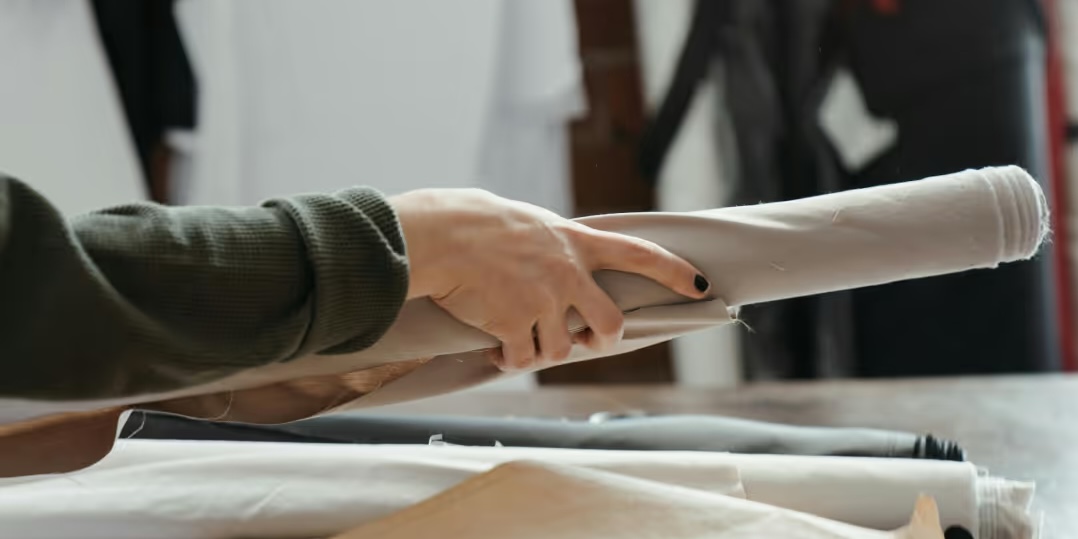
A loom operated by hand responds to tension differently with every pass. A skilled weaver feels when a thread is pulling too tight and adjusts before it becomes a flaw, while industrial looms cannot do this. They run at a fixed speed and tolerance, which works well for uniform synthetic yarns but strips the character out of natural fiber.
Hand-shearing alpaca, hand-sorting cotton bolls, and hand-finishing seams all take longer. They also produce garments with fewer structural weaknesses, because every stage involves a person checking the material rather than a sensor checking a tolerance range. That is why a well-made Pima cotton or Baby Alpaca garment can remain in rotation for a decade or more, softening with wear rather than breaking down.
How does Shipibo natural dyeing fit into this story?
The Shipibo people of the Peruvian Amazon have practiced natural dyeing for generations, using plant-based pigments drawn from bark, roots, and leaves rather than synthetic compounds. The resulting color sits differently in the fiber, often being warmer and slightly uneven in the most human way, carrying small variations that mark it as handmade rather than printed.
This process also avoids the heavy metal runoff and chemical waste associated with industrial dye baths, which are among the most polluting stages of conventional garment manufacturing. Working with Shipibo artisans is not a sustainability checkbox for Chirimoya.
Why does longevity matter more than recycling?
A garment that lasts fifteen years and gets worn every week does less environmental damage than a garment made from recycled material that falls apart after a season. Longevity is the quietest form of sustainability, and it is also the hardest to fake.
This is why Chirimoya measures success in how a sweater feels after the fiftieth wash, not in a certification sticker. The goal is a wardrobe of pieces that age the way good leather or well-seasoned wood does, gaining character rather than losing structure.
What makes Pima cotton more sustainable than regular cotton?
Pima cotton's extra-long fiber staple produces stronger, more durable thread, which means garments last significantly longer before wearing thin. Combined with lower water and pesticide use in traditional Andean growing regions, this longevity reduces the overall environmental footprint per garment worn over its lifetime.
Is handmade clothing actually more sustainable than factory-made clothing?
Yes, in most cases. Handmade garments from natural fibers tend to have fewer structural weak points, use less energy per piece, and avoid the chemical-heavy finishing processes common in industrial manufacturing, resulting in clothing that lasts years longer and needs replacing far less often.
What is Shipibo natural dyeing and why does it matter for sustainable fashion?
Shipibo natural dyeing is a traditional Peruvian Amazonian technique using plant-based pigments instead of synthetic chemical dyes. It produces richer, more organic color variation while avoiding the toxic runoff associated with industrial dye processes, making it both a cultural and environmental practice.
Explore the collection